Randy Weaver and his wife Bridget are the happy parents of healthy twin baby girls born on March 25, 2008.

Lily Anne: born 1:08 pm, 7 lbs 3 oz, 19.5 inches long.

Project Read at The Bridge at Main is the adult literacy program of the San Francisco Public Library. We help English-speaking adults improve their basic reading and writing skills so they may access greater opportunities in their lives. This is a friendly internet site where adult learners can share what they have written as part of their tutoring sessions or on their own.

2008 Marks the 25th Anniversary of Project Read
We are hoping to make this a special celebration which everyone will enjoy, but to do so we will need your help.
To get you in the mood, here’s a link to our January 2004 newsletter which featured pictures from our 20th Anniversary Party (on pages 8 & 9). Just click on the thumbnail below.
Thursday, February 21, 2008
6:00 — 7:30 p.m.
Main Library, Latino-Hispanic Meeting Room—Lower Level
Syllabify to Identify
Please call (415) 557-4388 if you plan to attend.


Some of the instructional ideas suggested by those attending the meeting included: using multi-sensory techniques to reinforce these word pattern & sound differences; making sure to reinforce the instruction by consistent weekly review; and using a formal, structured approach to teaching these skills by using one of the free instructional books available in the Project Read office.
One suggestion was to utilize the Duet Reading technique in which the tutor and learner read a text simultaneously with the tutor setting the pace. By reading more slowly and emphasizing punctuation, the learner will get in the habit of doing the same when he/she reads on their own. Another suggestion was for the tutor to tap out a slower rhythm that the learner can follow when he/she reads.
It was mentioned that there are a wide variety of books, covering many genres, and that although each title won't interest all learners, sooner or later there will be something that grabs their attention. One of the tutors spoke about the routine she uses to prepare her learner to attend the book club. They spend some time each week in their sessions discussing the reading, going over difficult vocabulary, and looking at the discussion/comprehension questions provided for each selection.
A tutor mentioned the useful tool of visualization--asking the learner to visualize what they are reading as they go. Other successful techniques to increase comprehension include paraphrasing what was read, mind-mapping, and asking the learner to look for specific information contained in the text before they start to read.


All meetings are held in the Project Read conference room and refreshments are provided.
If you haven't yet participated in Project Read's monthly Wednesday Night Readers Book Club, take a look at the following list of upcoming books to be discussed and hopefully you will find a selection that is just right for your learner. Remember, every learner who joins the book club receives a FREE book and audio book that they may keep. Their tutors can get a book, too!The Adventures of Tom Sawyer -- Mark Twain (book/audio book available after May 30) to be discussed at June 27 meeting.
Death of Salesman -- Arthur Miller (book/audio book available after June 27) to be discussed at July 25 meeting.
Shoeless Joe -- W. P. Kinsella (book/audio book available after July 25) to be discussed at August 29 meeting.
And Still I Rise -- Poetry by Maya Angelou (book/audio book available after August 29) to be discussed at September 26 meeting.
King Kong -- Edgar Wallace (book/audio book available after September 26) to be discussed at October 31 meeting.
Full Cupboard of Life -- Alexander McCall Smith (book/audio book available after October 31) to be discussed at November 28 meeting.
The Wednesday Night Readers meet on the last Wednesday of each month (except for December) from 6:00 to 7:30 p.m. at the Main Library, Latino-Hispanic Meeting Room--Lower Level.
These materials are made available free of charge thanks to an annual grant from the California State Library. We hope that each adult learner who takes a book and audio book will also attend the book club meeting and join their fellow Project Read members for a rewarding, enjoyable, and supportive discussion.
1. Before you take time off from tutoring, talk with your learner about what he/she would like to accomplish while you are away.
2. As a team, talk about the preparation your learner will need in order to work independently while you are away.
3. Come up with an agreed upon timeline for when your learner should finish the assignments. You might even suggest that you both stay in contact via e-mail while you are gone. This could be a way for your learner to keep you updated on his progress and maybe even ask questions.
4. If necessary, you may want to speak with the Project Read staff,
about what your learner will be working on while you are away, in order to coordinate support.

Spell It Deluxe (CD)
ReadPlease (Fully installed on our computers)
California Distance Learning Project (Link from our Learning Lab Links Page)
Ultimate Phonics (CD)
E-mail (Learning Lab Links page or http://www.yahoo.com/)
Blog (Learning Lab Links page or http://www.blogger.com/)
Listen to a Story (Use the library and our computers)
Before You Go
One method that was discussed was using word patterns to help the learner understand the common ways of spelling the sounds found in the English language.
A tutor also mentioned the importance of bringing multi-sensory techniques into the spelling instruction. One way of doing this is using word tiles (available in the Project Read instructional aids area of the office) or even index cards that can be moved about on the table thus providing kinesthetic reinforcement to what is being taught.
And someone mentioned that repetition is always an important component of instruction. We didn't learn a new literacy skill by doing something only once so why should we expect our adult learners to do so.
To help him remember how to leave enough space between the words he writes, she suggested that he use the erasure end of his pencil as a guide, making sure that there is the space of the erasure between each word.
When teaching her learner how to correctly gage the relative height of upper and lower case letters, she reminded him that lower case letters are one half the height of upper case on the page. For even more assistance in teaching writing, the Project Read office has lined classroom paper available for tutor-learner teams.
One tutor mentioned that when her learner turns in a writing sample, 70% of the words he has written might be misspelled. Because of this, she sometimes feels overwhelmed at how much there is to teach.
Other tutors in the meeting reminded her that it is a good thing that her learner has gotten to the point of getting his thoughts down on paper. This is a big step for many adult learners who are very unsure of spelling and grammar. And it is the first essential step in working on what needs to be taught.
One way to approach correcting the learner's many writing errors may be to look for common patterns which can be addressed rather than to try and focus on each individual error on the page. Are there word/syllable sounds that the learner consistently spells incorrectly? If so, try working on some word pattern exercises so he can begin understand the pattern for spelling these sounds. Similarly with punctuation, you can begin to address the forms of punctuation which are giving the learner the most difficulty one at a time.
The Project Read instructional resource collection has some excellent materials to provide a more structured approach to teaching these skills: Patterns in Spelling and Write All About It are two good examples.
At the April 3 Tutor Round Table meeting, tutors discussed these topics:
One suggestion was to ask her learner a specific question about what he is about to read--a literal comprehension question which he can find the answer to within two or three sentences of the text. This may help him stay more focused on what he is reading as he looks for the answer to your question.
A good resource to help teach comprehension skills is Help Yourself: How to Take Advantage of Your Learning Styles by Gail Murphy Sonbuchner. This book includes an excellent chapter covering strategies to help adult learners enhance their understanding and retention of what they read. This book is part of the Project Read instructional resources collection, located in the office, and it is available free to tutor-learner teams.
The Invisible Tutor:
Leona Whytus
Please keep an eye out for some additional posts coming your way which will highlight some of the neat things contained there.If you missed the February 15th Continuing Education Class for Project Read tutors, you can simply click on the title page above to view the entire PDF presentation. This is part of our efforts to provide valuable tutoring curricula and materials, in down-loadable format, through the Project Read website (http://www.projectreadsf.org/.)

A tutor discussed the challenge of helping her learner break some old habits which were developed over many years of trying to get by with limited reading skills. For example her learner often guesses at words rather than taking the time to decode them.
We also discussed the use of a structured workbook to teach basic reading skills.
There was also a discussion of which dictionaries are easier for learners to learn to use.
Beginner's Dictionary of American English which not only has examples of the word used the context of a sentence. The downside of this dictionary is that it's missing many words found in other, more advanced dictionaries.
Webster's New World Portable Large Print Dictionary which is easy on the eyes but heavy in the backpack or book bag. It has simply written definitions with less detail than dictionaries having regular size font.

A discussion followed about the importance of repetition and ongoing reinforcement of basic skills in the tutoring sessions. For most learners, it is not enough to address an error on a one-time basis. Instead, the problem words should be worked on at each session until the tutor is convinced that his/her learner can successfully decode and spell the word. In this effort it's important for the tutor to utilize multi-sensory techniques so that the learner is not only seeing the word on flash cards but also hearing it, and working with it in a kinesthetic, or tactile way (Scrabble tiles, tracing letters on desk or in the air, etc.). As tutors we sometimes forget that learners have a lifetime of making the same errors over and over because they never learned the basic skills necessary to be successful readers and writers. We can't expect them to learn these skills if we only address them once in a while during the tutoring sessions. It's the tutor's responsibility to create a lesson plan based on the needs of the learner and to follow through with that plan, providing the necessary repitition and reinforcement, at each meeting.
One tutor suggested that she talk with her learner about getting involved in the Wednesday Night Readers Book Club. Even if some of the books being read are a bit challenging for the learner, she/he can also listen to the recorded book (also provided FREE to all learners) and still participate in the monthly book discussion. The learner-friendly environment of the book club is a wonderful opportunity for learners to express their thoughts about what they have read and hear differing opinions from their fellow learners. The book club experience can really enhance the reader's enjoyment of a book. Previous book club selections, both books and tapes, are also available in the Project Read office to be checked-out by tutor-learner teams. For the October 25th Wednesday Night Readers meeting, learners and tutors are reading Something Wicked This Way Comes by Ray Bradbury (books & tapes still available in the office). For the November 29th meeting, the group will be reading God Rest Ye Merry Soldiers: A True Civil War Christmas Story by James McIvor.
One excellent suggestion was to keep track of the basic skills that these work-related tasks involve and at some point sit down with the learner, look at the list, and prioritize which skills are most important to the learner and which ones he or she would like to start working on first. Then create a long-range plan to teach those skills and work through that plan at each tutoring session.
A tutor suggested this simple mental exercise that might help the learner understand the commitment needed to reach his or her personal goals. The suggestion was to ask the learner if she or he has ever decided to learn or accomplish something, worked hard at it, and ultimately been successful. This can include just about anything in life--learning to play an instrument, learning to fix a car engine, completing a rehab. program, etc. Then ask them to describe what they did to be successful--what commitment did they make, and how much time did they devote to reaching this goal? Then, the learner can think about applying the same time and commitment to the reading and writing goals that he or she has set.
One creative suggestion was to have the learner record himself as he tells a story, and then ask the learner to use the recording as a basis for completing a writing exercise. And don't forget to praise the learner for his excellent vocabulary and speaking skills. Spoken language, after all, is the starting point for all writing.
The September Round Table discussion was a great example of just how helpful and informative these sessions can be. Everyone attending offered their suggestions, based on their own tutoring experience, and helped their fellow tutors find new ways to address a variety of instructional challenges. So come by and join the discussion at one of these upcoming Tutor Round Tables -- October 3 and November 7 (6:00 PM in the Project Read Conference Room).


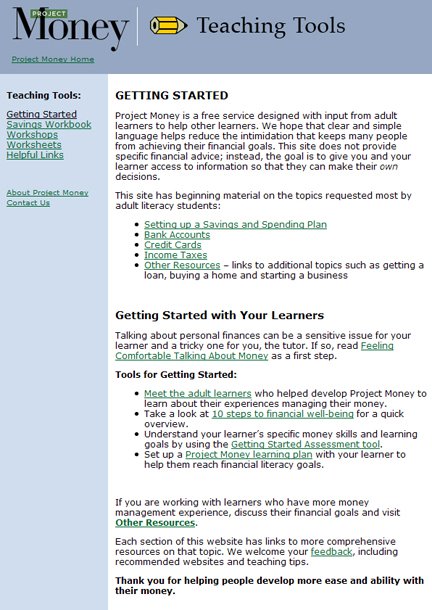
On Thursday, August 17, Project Read presented a continuing education workshop for volunteer tutors on the subject of helping adult learners achieve their financial literacy goals. This workshop focused on the learner-developed information (handbook and website) created by the Project Money team.
Highlights from the evening's workshop included:
A discussion of the barriers which prevent tutor-learner teams from working on financial goals. An excellent resource on this topic can be found on the Project Money website - www.projectmoney.org - in the Teaching Tools section. It's called "Feeling Comfortable Talking About Money" and it reviews reasons why adult learners may be sensitive about financial issues, and what tutors can do to make the learner feel safe in order to promote an open discussion of the topic. You can view this document at the following link: http://www.projectmoney.org/teaching/talking.html
We also discussed tools available on the website to help tutor-learner teams assess what the learner already knows about banking, credit, savings, etc., and what they need to learn: http://www.projectmoney.org/teaching/gettingstarted.doc (MS Word document) is a link to "Getting Started, a Self Assessment Tool". After working through this resource, you can go on to the next step of putting together a "Project Money Learning Plan": http://www.projectmoney.org/teaching/learningplan.doc (MS Word document).
Remember, the Project Money website has easy to understand information on many financial literacy topics. The information included on the site was researched and edited by adult learners themselves with the expert assistance of community advisors from financial institutions as well as volunteer tutors who then road- tested the instructional material.
One suggestion offered involved using the technique of DUET READING to help the learner understand how punctuation is used to add meaning to any style of writing. As you recall in duet reading the tutor and learner read a text simultaneously. In this way, the learner can begin to hear how punctuation influences the flow of reading and the meaning of what is being read.
To help beginning writers understand the nuances of grammar and punctuation we have handy FREE books available in the Project Read office. Two that might be hepful are: Punctuation Power: Punctuation and How to Use it, and Write All About It.
Here are some tips that came out of that meeting.