Welcome to Write Away!
The writing forum for Project Read learners.

We've redesigned our blog so that adult learners working at Project Read can share what they have written with other learners, tutors, and the public. There are a few simple guidelines to be aware of.
  1. This is a moderated site, so submissions and comments will first be reviewed before being approved and published.
  2. Adult learners submitting their writing have the option of using their first name (only) or using "anonymous" for authorship.
  3. We wish to honor the writing efforts of the adult learner/authors, so no major copy editing will be applied, but we may suggest minor corrections in consultation with the author.
  4. Only active Project Read learners are eligible to submit their writing to the Write Away blog and there are two ways of doing this: send submissions via email to projectread@sfpl.org, or stop by the office with a hard copy of your writing.
  5. The views and opinions expressed on this web site are solely those of the original authors and contributors. These views and opinions do not represent those of the San Francisco Public Library and/or the City and County of San Francisco.

Wednesday, May 14, 2008

Join the Book Club with Your Learner


Here is the schedule of books being read and discussed by Project Read's Wednesday Night Readers book club over the next few months. Please discuss these titles with your learner and make plans to pick up your FREE books and audio books and attend one of these exciting discussions. We make unabridged audio books available so that learners at any reading level can participate in the discussion. And look for special Movie Nights when we show film versions of these titles.

Cannery Row by John Steinbeck (discussed at June 25th meeting, books/audio books available May 28)

Of all Steinbeck's novellas, Cannery Row is the simplest story. It presents a slice of the lives of the men and women who populate a strip of sardine canneries after the workers go home. Set on California's Monterey Peninsula in the days long before famed golf courses and resorts, this post-depression tale depicts the life of an uproarious cast of characters: Lee Chong, the philosophical grocery store proprietor; Doc, the owner of the Western Biological Laboratory; Dora, the charitable Madame of the Bear Flag Restaurant, Mack, Hazel and Eddie and Hughie and Jones, the well-meaning residents of the Palace Flophouse, and, most important, Cannery Row herself, in all her ugliness and beauty, peace and violence. (192 pages)

Because of Winn Dixie by Kate DiCamillo (discussed at July 30 meeting, available June 25)

Because of Winn-Dixie, a big, ugly, happy dog, 10-year-old Opal learns 10 things about her long-gone mother from her preacher father. Because of Winn-Dixie, Opal makes new friends among the somewhat unusual residents of her new hometown, Naomi, Florida. Because of Winn-Dixie, Opal begins to find her place in the world and let go of some of the sadness left by her mother's abandonment seven years earlier. With her newly adopted, goofy pooch at her side, Opal explores her bittersweet world and learns to listen to other people's lives. This warm and winning book hosts an unforgettable cast of characters (192 pages)

The Natural by Bernard Malmud (discussed at August 27 meeting, available July 30)

Bernard Malamud’s first novel, published in 1952, is also the first—and some would say still the best—novel ever written about baseball. It is the story of a superbly gifted “natural” at play in the fields of the old daylight baseball era. This novel was the basis of the film of the same name starring Robert Redford. (237 pages)

Assassination Vacation by Sarah Vowell (discussed at September 24 meeting, available August 27)

What do you get when a woman who's obsessed with death and U.S. history goes on vacation? -- This wacky, weirdly enthralling exploration of the first three presidential assassinations. Vowell, a contributor to NPR's This American Life, takes readers on a pilgrimage of sorts to the sites and monuments that pay homage to Lincoln, Garfield and McKinley, visiting everything from grave sites and simple plaques to places like the National Museum of Health and Medicine, where fragments of Lincoln's skull are on display. An expert tour guide, Vowell brings into sharp focus not only the figures involved in the assassinations, but the social and political circumstances that led to each-and she does so in the witty, sometimes irreverent manner that her fans have come to expect. (272 pages)

Invasion of the Body Snatchers by Jack Finney (discussed at October 29 meeting, available September 24)

On a quiet fall evening in the small, peaceful town of Mill Valley, California, Dr. Miles Bennell discovered an insidious, horrifying plot. Silently, subtly, almost imperceptibly, alien life-forms were taking over the bodies and minds of his neighbors, his friends, his family, the woman he loved -- the world as he knew it. First published in 1955, this classic thriller of the ultimate alien invasion and the triumph of the human spirit over an invisible enemy inspired three major motion pictures. (224 pages)


Wednesday, April 23, 2008

National Volunteer Week Treat

(Non-redeemable sample of the discount coupon letter)

Gentle Reader,


In recognition of National Volunteer Week (April 27 - May 3, 2008), our good friends at Stacey's Booksellers are once again honoring all Project Read volunteers by offering to them a whopping 20% discount on the purchase of any books in stock. This generous offer is valid until June 30, 2008.

On April 21st we mailed letters containing a 20% discount coupon to all active Project Read volunteers. If you are an active Project Read of the San Francisco Public Library volunteer and have not received your letter/discount coupon, then please contact the Project Read office and we'll make things right.

All the best, Brian

Monday, April 21, 2008

Tutor Training Tune-Up Tomorrow


Gentle Tutor,

Please accept this reminder that 6:00p.m. tomorrow night (Tuesday April 22, 2008) is a rare chance for follow-up time with our co-tutor-trainer Holly Fulghum-Nutters. Bring your questions, observations, and inquiring mind. She’ll give you more strategies and food for thought than you can shake a dictionary at!

Give us a call at 557-4388 if you can join us. Biscotti will be served.

All the best, Brian

Tuesday, April 15, 2008

Library Legislative Day


Hey Folks,


As you may know, there is a proposed 10% cut to the California State Budget. This includes public libraries and the many services they provide to our community - including literacy services such as Project Read.

Tomorrow, Wednesday April 16, 2008 is Library Legislative Day. Many library staff members and supporters will visit Sacramento to meet with their local representatives and inform them of the importance of libraries
. Many others will contact their representatives by phone, post, and e-mail to suggest that cutting these vital services is not in the best interest of the State of California.

If you are interested in finding out more about this event, and perhaps even participating, then please click on this link to the California Library Association.

If you would like to find contact information for your local representatives, then please click on this link to the Easy Voter Guide.

All the best, Brian

Wednesday, March 26, 2008

Randy, Double Daddy-O

(Click on the images below to view larger versions)

They’ve arrived!

Randy Weaver and his wife Bridget are the happy parents of healthy twin baby girls born on March 25, 2008.

Nora Kathleen: born 1:07 pm, 5 lbs 13 oz, 19 inches long.
Lily Anne: born 1:08 pm, 7 lbs 3 oz, 19.5 inches long.

Mother and father are resting comfortably, for now.

Thursday, February 14, 2008

Help Us Plan a 25th Anniversary Celebration


2008 Marks the 25th Anniversary of Project Read

We’d like to put together a team of learners and tutors to help us plan an exciting event to be held this fall. If you would like to participate as a member of this planning committee (probably involving no more than one meeting a month to start) please let us know by calling (415) 557-4388. If you have further questions, please ask for Randy.

We are hoping to make this a special celebration which everyone will enjoy, but to do so we will need your help.

To get you in the mood, here’s a link to our January 2004 newsletter which featured pictures from our 20th Anniversary Party (on pages 8 & 9). Just click on the thumbnail below.

Wednesday, January 23, 2008

Continuing Education Class for Tutors


Thursday, February 21, 2008

6:00 — 7:30 p.m.

Main Library, Latino-Hispanic Meeting Room—Lower Level

Syllabify to Identify

Join literacy professional Lucille Cuttler to explore how knowledge of common syllable types improves spelling and decoding skills. Count on seeing fun strategies that build on material in your initial tutor training. Also discover how to reinforce this learning in the computer lab.

Please call (415) 557-4388 if you plan to attend.


Friday, November 30, 2007

Start the New Year by attending a Tutor Round Table Meeting!


Are you searching for some fresh tutoring strategies? Are you itching to share a recent breakthrough you have had in your tutoring sessions? Perhaps you would simply like to reconnect with some of your fellow Project Read tutors. If so, plan to attend a Tutor Round Table meeting in the New Year. We'll provide the pizza and support--you can provide the valuable collaborative discussion. Here's a schedule of meetings through June 2008.
  • Tuesday, January 8, 6:00-7:30 pm
  • Saturday, February 2, 1:00-2:30 pm
  • Tuesday, March 4, 6:00-7:30 pm
  • Saturday, April 5, 1:00-2:30 pm
  • Tuesday, May 6, 6:00-7:30 pm
  • Saturday, June 7, 1:00-2:30 pm
Round Table meetings are held in the Project Read conference room. Please call our office at (415) 557-4388 if you plan to attend a meeting. We look forward to seeing you!

Monday, October 15, 2007

Project Read Holiday Party & Potluck


December 13, 2007
6:00 - 8:00 p.m.
Main Library

Project Read members and staff will again come together to celebrate the holiday season with a festive party and potluck on Thursday, December 13th from 6:00 to 8:00 p.m. Don’t miss this opportunity to sample some amazing home cooking and spend a fun evening with other tutors and learners. We will also have some special door prizes and FREE raffle gifts donated by local businesses.

We are looking for some fabulous goods or professional services that can be given away during the evening’s free raffle. Please consider asking your employer to make a donation for this event. Here are some examples of previous donations: magazine subscriptions, tickets for brunch at a local hotel, gift certificates for a bookstore, and movie passes.

So mark your calendars for the evening of Thursday, December 13th. Invitations will be mailed to everyone in November. We look forward to seeing you there!


Monday, October 01, 2007

Tutor Workshop -- Thursday, October 18


Putting Words on the Page

Join literacy professional Amy Prevedel to explore tutoring techniques that can motivate even the most reluctant writers. You will practice specific ways to initiate and respond to your learner’s writing that will strengthen his/her fluency, spelling, grammar, punctuation, and self-confidence.

Thursday, October 18, 2007
6:00 — 7:30 p.m.
Main Library, Latino-Hispanic Meeting Room—Lower Level
Please call (415) 557-4388 if you plan to attend.

Thursday, August 09, 2007

Notes from August Tutor Round Table Meeting

The Tutor Round Table meeting on Tuesday, August 7 was very well attended. Here are some of the topics which were discussed:


  • One tutor spoke about the difficulty her learner has in distinguishing the difference between certain sounds and spellings, for example: when/went.

Some of the instructional ideas suggested by those attending the meeting included: using multi-sensory techniques to reinforce these word pattern & sound differences; making sure to reinforce the instruction by consistent weekly review; and using a formal, structured approach to teaching these skills by using one of the free instructional books available in the Project Read office.

  • Another tutor mentioned that her learner makes a lot of reading errors because he/she is simply trying to read too quickly.

One suggestion was to utilize the Duet Reading technique in which the tutor and learner read a text simultaneously with the tutor setting the pace. By reading more slowly and emphasizing punctuation, the learner will get in the habit of doing the same when he/she reads on their own. Another suggestion was for the tutor to tap out a slower rhythm that the learner can follow when he/she reads.

  • A tutor mentioned that although she has tried to get her learner interested in joining the Wednesday Night Readers Book Club, there hasn't been a book that has looked interesting to the adult learner.

It was mentioned that there are a wide variety of books, covering many genres, and that although each title won't interest all learners, sooner or later there will be something that grabs their attention. One of the tutors spoke about the routine she uses to prepare her learner to attend the book club. They spend some time each week in their sessions discussing the reading, going over difficult vocabulary, and looking at the discussion/comprehension questions provided for each selection.

  • A tutor mentioned that her learner still has difficulty with reading comprehension and understanding the basic information contained in a story or article.

A tutor mentioned the useful tool of visualization--asking the learner to visualize what they are reading as they go. Other successful techniques to increase comprehension include paraphrasing what was read, mind-mapping, and asking the learner to look for specific information contained in the text before they start to read.

Monday, July 30, 2007

Continuing Education Class for Project Read Tutors


Tips on Locating Phonetic Gaps
Presented by Joan Sykes-Miessi
Literacy Coordinator, San Mateo County Library


Join us and discover easy-to-use techniques to help pinpoint the gaps in your learner’s knowledge of phonics and learn new strategies to address what needs to be taught.


Thursday, August 16, 2007
6:00—7:30 p.m
.
Main Library—Latino-Hispanic Meeting Room—Lower Level
Please call 415-557-4388 if you plan to attend.

Friday, June 15, 2007

Reading Minds Video Now Online

 (The links and some of the text on this post were updated on May 14, 2014 by Brian)

Howdy Folks,
The powerful short film Reading Minds is now online at Current TV and Google Video. It was created for Current TV by Bay Area filmmaker Kevin Epps. It offers a window into the inspiring work of Project Read - the adult literacy program of the San Francisco Public Library. It portrays the challenges and triumphs of Leon Veal and Maurice Roberson, two adult learners who have improved their basic literacy skills and continue to achieve important life goals. For more information about Project Read of the San Francisco Public Library, please go to www.projectreadsf.org.

 You can view the film by clicking the Play Button below. Enjoy, Brian


Below are image snapshots from newsletter articles written by or about Maurice or Leon. We will provide links to the original newsletters in the near future - once we have created an online newsletter archive.


Wednesday, June 06, 2007

Tutor Round Table Schedule: July - November 2007

Here is a schedule of Tutor Round Table meetings for the remaining months of 2007. You are invited to join your fellow tutors and program staff for these informal and informative discussions which can help provide some new and effective strategies to enhance your instructional sessions.
  • Saturday, July 7: 1:00 - 2:30 p.m.
  • Tuesday, August 7: 6:00 - 7:30 p.m.
  • Saturday, September 8: 1:00 - 2:30 p.m.
  • Tuesday, October 2: 6:00 - 7:30 p.m.
  • Tuesday, November 6: 6:00 - 7:30 p.m.

All meetings are held in the Project Read conference room and refreshments are provided.

Tuesday, May 15, 2007

Join the Wednesday Night Readers Book Club!

If you haven't yet participated in Project Read's monthly Wednesday Night Readers Book Club, take a look at the following list of upcoming books to be discussed and hopefully you will find a selection that is just right for your learner. Remember, every learner who joins the book club receives a FREE book and audio book that they may keep. Their tutors can get a book, too!

The Adventures of Tom Sawyer -- Mark Twain (book/audio book available after May 30) to be discussed at June 27 meeting.

Death of Salesman -- Arthur Miller (book/audio book available after June 27) to be discussed at July 25 meeting.

Shoeless Joe -- W. P. Kinsella (book/audio book available after July 25) to be discussed at August 29 meeting.

And Still I Rise -- Poetry by Maya Angelou (book/audio book available after August 29) to be discussed at September 26 meeting.

King Kong -- Edgar Wallace (book/audio book available after September 26) to be discussed at October 31 meeting.

Full Cupboard of Life -- Alexander McCall Smith (book/audio book available after October 31) to be discussed at November 28 meeting.

The Wednesday Night Readers meet on the last Wednesday of each month (except for December) from 6:00 to 7:30 p.m. at the Main Library, Latino-Hispanic Meeting Room--Lower Level.

These materials are made available free of charge thanks to an annual grant from the California State Library. We hope that each adult learner who takes a book and audio book will also attend the book club meeting and join their fellow Project Read members for a rewarding, enjoyable, and supportive discussion.


Sunday, April 29, 2007

Invisible Tutor Workshop Handouts

Howdy Folks,

On Tuesday, April 24, 2007, Randy, Leon, and Brian facilitated a workshop designed to help tutors work with their learners in creating engaging assignments that promote independent learning and maintain momentum in the tutor's absence.

Below you will find the text as well as downloadable JPG conversions of the workshop outline and computer tips handout.
We will soon post MS Word and PDF versions of these 2 documents in the Instructional Resources section of the Project Read SFPL Website (www.projectreadsf.org).

Please let us know if these documents prove helpful and/or strike you as in need of a smidge of revision.

All the best, Brian


Project Read
Continuing Education Class for Tutors
April 24, 2007

The Invisible Tutor


General Suggestions


1. Before you take time off from tutoring, talk with your learner about what he/she would like to accomplish while you are away.

  • Reinforce skills which have already been introduced in your tutoring sessions: phonics, spelling, writing/grammar, etc.
  • Finish an assignment that he/she has already begun: newsletter article, distance learning exercise, journal writing, etc.
  • Work on new exercises/assignments: spelling/writing workbooks, computer learning software, etc.

2. As a team, talk about the preparation your learner will need in order to work independently while you are away.

  • What resources will your learner need access to--computer lab software/Internet access, writing journal, workbook exercises?
  • What can you do to make it easier for your learner to work successfully on these assignments? For example, you probably want to review each exercise you are assigning and go over specific examples together in order to model exactly what your learner is being asked to do.

3. Come up with an agreed upon timeline for when your learner should finish the assignments. You might even suggest that you both stay in contact via e-mail while you are gone. This could be a way for your learner to keep you updated on his progress and maybe even ask questions.

4. If necessary, you may want to speak with the Project Read staff,
about what your learner will be working on while you are away, in order to coordinate support.


The Invisible Tutor Workshop – Computer Tips


Spell It Deluxe (CD)

  • Go through the word list binders with your learner to find lists that he/she finds interesting. Photocopy and write due dates on them to remind your learner which ones to do and when.
  • Create custom word lists from the extensive selection built into Spell It.


ReadPlease (Fully installed on our computers)

  • Work with your learner to create some ReadPlease documents and save them in a folder. Could be news stories, fiction, personal writing, language experience stories, lessons that need revision/correction, etc. Possibly end with questions for learner to type answers to.
  • Set assignment of finding information on the web (SF Gate, wikipedia, etc.) and cutting, pasting, and saving into ReadPlease.
  • Put some vocabulary words in ReadPlease for learner to write sentences around.


California Distance Learning Project (Link from our Learning Lab Links Page)

  • Look through the categories and stories to pick a few that interest your learner. Print out the pages that show the stories, circle the stories, and put in learner’s lab folder.
  • Pick a few stories and prepare some follow up lessons to them. Vocabulary, researching related stories, etc.

Ultimate Phonics (CD)

  • Pick specific lessons that target sounds you are working on. Print out the word lists ahead of time.
  • Use the Ultimate Phonics manual to plan some lessons.

E-mail (Learning Lab Links page or http://www.yahoo.com/)

  • Ask your learner to e-mail the completed or in-progress assignments to you while you are away.
  • Structure some e-mail based lessons that go back and forth.


Blog (Learning Lab Links page or http://www.blogger.com/)

  • Work with Brian to create a blog that you and learner can both log into. Practice with learner. Set up schedule of posting some daily events, writing, photos, etc.

Listen to a Story (Use the library and our computers)

  • Go with your learner to the CD and audio book sections of the library to pick some books, stories, radio programs, etc. that your learner is interested in. Have your learner use the computer lab to listen to the stories and complete some written assignments you prepare ahead of time.

Before You Go

  • Work with your learner to choose assignments that are interesting to him/her, further his/her literacy goals, and are not too difficult or complex to undertake on own.
  • Take the time to model the tasks / steps necessary to complete the assignments.

Monday, April 09, 2007

Annual Tutor-Learner Recognition -- June 7, 2007

Please save this date:
Thursday, June 7, 2007
6:00 - 8:00 p.m.
Project Read's Tutor-Learner Recognition


How has your experience as a learner or tutor
changed your life?

At this year’s recognition event, we would like to encourage both tutors and learners to think about how your life has changed since becoming involved with Project Read. Please write a brief (one page or less) description about a positive experience you have had as a tutor or a learner. If you like, you may share what you have written during the program that evening. Here are just a few ideas that tutors and learners might consider writing about.


1. What was it like for you when you first started at Project Read, and how is it different now?

2. In what ways has your learner or tutor made a difference in your life?

3. What have you learned from working with your adult learner or volunteer tutor?

Please send your submissions, electronically if possible, to Richard by May 18, 2007. You may also bring him a floppy disk or hard copy.


Formal invitations to this June 7th event will be coming your way later in the spring.

Wednesday, April 04, 2007

Tutor Tips from the March 31 & April 3 Round Table Meetings

At the first ever Tutor Round Table meeting held on a Saturday, tutors discussed the following topics:

  • A tutor mentioned that she and her learner are primarily focusing on basic spelling skills and asked for ideas to enhance her instruction.

One method that was discussed was using word patterns to help the learner understand the common ways of spelling the sounds found in the English language.

A tutor also mentioned the importance of bringing multi-sensory techniques into the spelling instruction. One way of doing this is using word tiles (available in the Project Read instructional aids area of the office) or even index cards that can be moved about on the table thus providing kinesthetic reinforcement to what is being taught.

And someone mentioned that repetition is always an important component of instruction. We didn't learn a new literacy skill by doing something only once so why should we expect our adult learners to do so.

  • Another tutor shared some excellent ideas she had for teaching her learner how to print legibly.

To help him remember how to leave enough space between the words he writes, she suggested that he use the erasure end of his pencil as a guide, making sure that there is the space of the erasure between each word.

When teaching her learner how to correctly gage the relative height of upper and lower case letters, she reminded him that lower case letters are one half the height of upper case on the page. For even more assistance in teaching writing, the Project Read office has lined classroom paper available for tutor-learner teams.

  • Tutors also engaged in a helpful discussion of how to teach writing skills.

One tutor mentioned that when her learner turns in a writing sample, 70% of the words he has written might be misspelled. Because of this, she sometimes feels overwhelmed at how much there is to teach.

Other tutors in the meeting reminded her that it is a good thing that her learner has gotten to the point of getting his thoughts down on paper. This is a big step for many adult learners who are very unsure of spelling and grammar. And it is the first essential step in working on what needs to be taught.

One way to approach correcting the learner's many writing errors may be to look for common patterns which can be addressed rather than to try and focus on each individual error on the page. Are there word/syllable sounds that the learner consistently spells incorrectly? If so, try working on some word pattern exercises so he can begin understand the pattern for spelling these sounds. Similarly with punctuation, you can begin to address the forms of punctuation which are giving the learner the most difficulty one at a time.

The Project Read instructional resource collection has some excellent materials to provide a more structured approach to teaching these skills: Patterns in Spelling and Write All About It are two good examples.

At the April 3 Tutor Round Table meeting, tutors discussed these topics:

  • A tutor spoke of the challenge she is having as she tries to teach her learner how to improve his comprehension skills. She is already doing pre and post reading activities for each reading selection they work on.

One suggestion was to ask her learner a specific question about what he is about to read--a literal comprehension question which he can find the answer to within two or three sentences of the text. This may help him stay more focused on what he is reading as he looks for the answer to your question.

A good resource to help teach comprehension skills is Help Yourself: How to Take Advantage of Your Learning Styles by Gail Murphy Sonbuchner. This book includes an excellent chapter covering strategies to help adult learners enhance their understanding and retention of what they read. This book is part of the Project Read instructional resources collection, located in the office, and it is available free to tutor-learner teams.

Thursday, March 29, 2007

Continuing Ed. Class for Project Read Tutors--April 24

The Invisible Tutor:
Creating exercises and assignments that your learner
will love to work on when you’re away.


This hands-on workshop, presented by Project Read staff, will give you some easy-to-use materials and strategies to encourage your learner to work independently to enhance his or her reading, writing, and study skills.

Tuesday, April 24, 2007
6:00 — 7:30 p.m.
Project Read Conference Room and Computer Lab
Please call (415) 557-4388 if you plan to attend.

Wednesday, March 21, 2007

Writer to Writer Challenge for Adult Learners

Leona Whytus
2006 Writer to Writer
First Place Winner

Once again this year, the California State Library (along with the Bay Area Literacy Network and the Southern California Library Literacy Network) is sponsoring the Writer to Writer Challenge for adult learners in library-based literacy programs in California.

The Writer to Writer Challenge is simple; adult learners are asked to write a letter to the author of a book they have read, or listened to, which has really inspired them. Last Year, Project Read's Leona Whytus came in first place for the letter she wrote to Mildred D. Taylor author of Roll of Thunder Hear My Cry which Leona read as a member of the Wednesday Night Readers Book Club.

The State Library has even provided a very helpful collection of writing exercises for tutor-learner teams to use in preparation for submitting a letter to the Writer to Writer Challenge. These materials, along with the official Writer to Writer entry forms, are available in the Project Read office. We will also be happy to mail these packets to tutor-learner teams who may not be meeting at the Main Library. We hope to make the forms available online soon.

The deadline for submitting your letters is June 30, 2007.
Happy writing!

(Click on the the picture of the flyer above to see it larger and/or print it letter size)

Friday, March 09, 2007

Statewide Public Awareness Campaign for Library Literacy Programs

(California Library Literacy Services Billboard at the corner of Van Ness & Turk)

During 2005 and 2006, the California State Library conducted a statewide survey of library literacy program participants in order to determine the most effective ways of promoting our services. One of the results of this research is now visible on streets and highways throughout California. We have already received a few calls directed to our office from the statewide referral number shown on the billboards. So keep an eye open for these billboards as you stroll or drive through the city or around the state.

New Instructional Materials FREE for Tutor-Learner Teams


We have added some new books to our collection of instructional materials which are available in the Project Read office. Tutors and learner teams may have these materials free of charge to use in your tutoring sessions and keep.


Help Yourself: How to Take Advantage of Your Learning Styles by Gail Murphy Sonbuchner

This book is written for the adult leaner who is seeking to discover his or her own learning strengths and the strategies to successfully take advantage of those strengths. The chapters cover topics such as organization and time management, memory, listening, reading comprehension, writing, and test taking skills.


Filling Out Forms published by New Readers Press

This book introduces a wide range of forms and applications that we are all faced with filling out from time to time in our daily lives. Excellent background information is included as well as generic examples of forms used in banking, education, health care, driving, citizenship, and voting.


Spelling Smart!: A Ready-to-Use Activities Program for Students with Spelling Difficulties by Cynthia M. Stowe

This is a comprehensive (414 page) workbook which introduces concepts of phonics and progresses to cover spelling rules for the English language.


Reading Smarter!: More than 200 Reproducible Activities to Build Reading Proficiency by Patricia Osborn

For the advanced level Project Read learner, this is an excellent collection of exercises and activities designed to improve comprehension and critical reading skills.


Writing Smarter!: Over 100 Step-by-Step Lessons with Reproducible Activity Sheets to Build Writing Proficiency by Keith Manos

This collection of writing activities and exercises is designed for a tutor-learner team working on higher level writing skills. Chapters include information on sentence analysis, editing, writing formal letters, writing poetry, and even writing news stories.

Wednesday, March 07, 2007

Notes from March 6 Tutor Round Table

The March 6 Tutor Round Table meeting was attended by both experienced tutors as well as a tutor who had just been matched with her adult learner. Here are some of the topics which were discussed:


  • A tutor who is working heavily on writing skills with his learner mentioned that the free instructional workbooks available in the Project Read office have been extremely helpful. He specifically mentioned Write All About It (student book and teacher's manual) which he found useful in teaching basic grammar skills using a very structured approach.
  • Another tutor mentioned that the specific writing skills which need to be taught really depend on the goals of the learner. Her learner's writing goals are limited so she and her learner are not currently working on the higher level grammar skills.
  • One tutor in attendance mentioned that her learner may have some learning differences which make decoding individual words even more challenging. It was suggested that patience, repetition, and the use of multi-sensory instructional techniques are the keys to assisting these learners. She went on to say that her learner does feel that he is making real progress and she can see it too.
  • There was also a discussion of how to effectively praise an adult learner. One tutor mentioned the importance of varying your response. As an example, here's a link to a great list called 101 Ways to Say "Good Job" http://www.bozeman.k12.mt.us/humanresources/sub/101ways.html . It was also suggested that a tutor's praise could be focused on specific things the learner is doing right. For example, if your learner spells a contraction correctly for the first time, point to the word and mention that he/she did a great job so that the correct spelling is reinforced.
  • Finally, there was a discussion of where to obtain news and current event articles that are accessible for adult learners. Some suggestions included: USA Today (written at a slightly easier reading level than other newspapers, and with more pictures), News For You (a weekly newspaper published for adult learners, available in Project Read office), Readers Digest, and the California Distance Learning Project link on the Project Read computer lab homepage - http://www.cdlponline.org/ - which includes articles and comprehension exercises on a wide range of topics.

Tuesday, March 06, 2007

First Ever Saturday Tutor Round Table!

On Saturday, March 31, Project Read tutors are invited to attend a specially scheduled Tutor Round Table meeting in the Project Read office from 1:00 to 2:30 PM.

Join your fellow Project Read tutors and staff to share ideas, instructional strategies, and tasty pizza. This is the first ever Saturday meeting of the popular Round Table, so come on by and take advantage of this great opportunity to collaborate and sharpen your tutoring skills.
Please call the Project Read office at (415) 557-4388 if you plan to attend.

Wednesday, February 21, 2007

Project Read Instructional Resources Page

Howdy Tutors, Adult Learners, and Other Interested Folks,

We have been hard at work for the last few months collaborating with the SFPL Web Team to post Microsoft Word and PDF versions of a pretty hefty assortment of original Project Read curricula and administrative forms. We have lots of fabulous things there so please poke around and let us know if this is helpful.
All you need do is click on the image below.

Please keep an eye out for some additional posts coming your way which will highlight some of the neat things contained there.

All the best, Brian

Notes from Poetry Workshop

If you missed the February 15th Continuing Education Class for Project Read tutors, you can simply click on the title page above to view the entire PDF presentation. This is part of our efforts to provide valuable tutoring curricula and materials, in down-loadable format, through the Project Read website (http://www.projectreadsf.org/.)


Wednesday, February 07, 2007

Tips for Tutors from the February Round Table


Here are some of the topics discussed at the February Tutor Round Table meeting:


A tutor discussed the challenge of helping her learner break some old habits which were developed over many years of trying to get by with limited reading skills. For example her learner often guesses at words rather than taking the time to decode them.


  • The tutor mentioned that she often simply reminds her learner that it's okay to slow down and not be in a rush to finish a piece of reading material. In doing this, her learner is paying more attention to what is being read and doing less guesswork.

We also discussed the use of a structured workbook to teach basic reading skills.


  • One tutor mentioned that she wasn't sure how her learner would respond to working with the Patterns in Spelling series. She was happy to find that the learner enjoyed the structured lessons and the ability to look back at previous exercises to see what had been accomplished. Using the workbook also gave the tutor some needed support in teaching some very basic skills.

There was also a discussion of which dictionaries are easier for learners to learn to use.


  • A few tutors commented that the more advanced dictionaries were often overwhelming to beginning readers, especially all the abbreviations indicating derivation and parts of speech which often follow the word.

  • Two dictionaries, available to all learners, which are slightly easier to use are:

Beginner's Dictionary of American English which not only has examples of the word used the context of a sentence. The downside of this dictionary is that it's missing many words found in other, more advanced dictionaries.


Webster's New World Portable Large Print Dictionary which is easy on the eyes but heavy in the backpack or book bag. It has simply written definitions with less detail than dictionaries having regular size font.


Thursday, February 01, 2007

Wednesday Night Readers Book Club


Tutors: are you looking for a way to help your learner discover the pleasures of reading and to encourage him/her to read more away from your tutoring sessions? If so, talk with your learner about joining the Wednesday Night Readers Book Club... and you can join, too!

Members of the book club receive FREE copies of the selected book and adult learners can also pick up a FREE unabridged audio book. Then on the last Wednesday evening of the each month, we all come together for a friendly and engaging book discussion. The discussions are facilitated by two longtime Project Read volunteers who are talented at creating a nurturing and non-threatening environment for the free expression of ideas. It's a great experience for both learners and their tutors.

Here is a list of books which we will be reading and discussing over the next few months:

February 28 meeting -- Black Like Me by John Howard Griffin
(book available now)

March 28 meeting -- The Bridge of San Luis Rey by Thornton Wilder
(book available on or after Feb. 28)

April 25 meeting -- Island of the Blue Dolphins by Scott O'Dell
(book available on or after March 28)

May 30 meeting -- Teacher Man by Frank McCourt
(book available on or after April 25)

Feel free to call the Project Read office (415-557-4388) for more information. We look forward to seeing you there!

Friday, January 19, 2007

Continuing Education Class for Tutors - Feb. 15

Using Poetry to Enrich Basic Literacy Instruction
Presented by Randy Weaver — Project Read Manager

Join us for this fun and interactive workshop where you will
discover how poetry and song lyrics can be used to teach basic
skills while adding variety and excitement to your tutoring sessions.

Thursday, February 15, 2007
6:00 — 7:30 p.m.
Main Library—Latino-Hispanic Meeting Room—Lower Level

Please call (415) 557-4388 if you plan to attend.

Friday, January 12, 2007

Tutor Round Table Meetings 2007

Tutor Round Table meetings are informal gatherings of tutors and staff for the purpose of sharing ideas and offering new strategies for instruction.

Join us at a Round Table meeting in 2007 -- they are held in the Project Read conference room and refreshments are provided.

Tuesday, January 2 -- 6:00 - 7:30 p.m.
Tuesday, February 6 -- 6:00 - 7:30 p.m.
Tuesday, March 6 -- 6:00 - 7:30 p.m.
Saturday, March 31 -- 1:00 - 2:30 p.m.
Tuesday, April 3 -- 6:00 - 7:30 p.m.
Tuesday, May 1 -- 6:00 - 7:30 p.m.
Saturday, July 7 -- 1:00 - 2:30 p.m.
Tuesday, August 7 -- 6:00 - 7:30 p.m.
Saturday, September 8 -- 1:00 - 2:30 p.m.
Tuesday, October 2, -- 6:00 - 7:30 p.m.
Tuesday, November 6 -- 6:00 - 7:30 p.m.

No Round Table meeting scheduled for December


Wednesday, November 08, 2006

Tips for Tutors from the November Round Table Discussion

At the monthly Tutor Round Table discussion, tutors had a lot to say about the following topics:

On encouraging their adult learners to write...
One tutor said her learner showed immediate interest in writing in a Response Journal. The learner's first entry was a page long! The tutor and learner will pass the journal back and forth responding to what each other have written. The tutor was careful to remind the learner that what she writes in the journal doesn't have to be perfect; spelling and grammar are not as important as just getting thoughts down on paper as a first step.

Another tutor at the meeting mentioned that his learner is quite comfortable taking risks when writing, which of course is a great way to learn. His learner turns in as many as 3 or 4 pages of written material which the tutor-learner team then goes over to look for random mistakes and patterns of errors. His learner is highly motivated to start working on punctuation and grammar.

A third tutor at the meeting said that her learner is less comfortable sharing the very personal things that she writes about in her journal. She keeps her journal writings to herself and uses what she writes as a way to deal with life's challenges. Everyone agreed that writing as often as possible, even when material is not shared with the tutor, is a step in the right direction.

On improving comprehension skills...
A tutor at the discussion asked about methods she could use to help her learner improve her comprehension skills. The importance of working on pre-reading activities was discussed. Ideas that were shared included: using a Mind Map to brainstorm vocabulary that the learner already knows regarding the topic he/she is preparing to read about; asking specific literal comprehension question before the learner reads so that he/she stays focused while looking for the answer to the question; using photos accompanying a book or article to generate a pre-reading discussion of what the material might be about; scanning the reading material to locate words that might be difficult for the adult learner--this can be done beforehand by the experienced tutor who knows the vocabulary that is likely to challenge the learner or together as a tutor-learner team before the material is read by the learner.

Thursday, October 05, 2006

News for You -- a weekly newspaper for adult learners available in Project Read office


News for You, a weekly newspaper written for adult learners and published by New Readers Press, is now available in the Project Read office. This four-page newspaper contains easy-to-read stories about national events, sports, famous people, as well as special features. New Readers Press has complied a list of instructional tips for tutors/teachers using News for You with their learners.
Follow this link http://www.news-for-you.com/teachers/index_headlines.html then click on "Teaching Tips" on left side of web page.

Wednesday, October 04, 2006

Notes from October Tutor Roundtable Meeting

Two topics dominated the discussion at the Tutor Round Table Meeting on October 3rd.

  • One tutor asked why his learner may still be having trouble decoding simple sight words even after the tutor points out the error.

A discussion followed about the importance of repetition and ongoing reinforcement of basic skills in the tutoring sessions. For most learners, it is not enough to address an error on a one-time basis. Instead, the problem words should be worked on at each session until the tutor is convinced that his/her learner can successfully decode and spell the word. In this effort it's important for the tutor to utilize multi-sensory techniques so that the learner is not only seeing the word on flash cards but also hearing it, and working with it in a kinesthetic, or tactile way (Scrabble tiles, tracing letters on desk or in the air, etc.). As tutors we sometimes forget that learners have a lifetime of making the same errors over and over because they never learned the basic skills necessary to be successful readers and writers. We can't expect them to learn these skills if we only address them once in a while during the tutoring sessions. It's the tutor's responsibility to create a lesson plan based on the needs of the learner and to follow through with that plan, providing the necessary repitition and reinforcement, at each meeting.

  • Another tutor at the Round Table asked for ideas she can use to address her learner's goal of reading for pleasure.

One tutor suggested that she talk with her learner about getting involved in the Wednesday Night Readers Book Club. Even if some of the books being read are a bit challenging for the learner, she/he can also listen to the recorded book (also provided FREE to all learners) and still participate in the monthly book discussion. The learner-friendly environment of the book club is a wonderful opportunity for learners to express their thoughts about what they have read and hear differing opinions from their fellow learners. The book club experience can really enhance the reader's enjoyment of a book. Previous book club selections, both books and tapes, are also available in the Project Read office to be checked-out by tutor-learner teams. For the October 25th Wednesday Night Readers meeting, learners and tutors are reading Something Wicked This Way Comes by Ray Bradbury (books & tapes still available in the office). For the November 29th meeting, the group will be reading God Rest Ye Merry Soldiers: A True Civil War Christmas Story by James McIvor.

Saturday, September 16, 2006

Continuing Ed. Class for Tutors

UNCOVER THE ROOTS!
Thursday, October 19, 2006
6:00 - 7:30 p.m.
Main Library - Latino/Hispanic Room - Lower Level

Tutors are invited to this interactive workshop where you will learn new strategies to help your learner break down those difficult l o n g words by identifying the roots, prefixes and suffixes of the word.
Presented by Lucille Cuttler, Reading Specialist & Project Read Tutor
Please call the Project Read office @ 415.557.4388 if you plan to attend.

Wednesday, September 06, 2006

Tips for Tutors from the September Round Table Meeting

At the Tutor Round Table meeting on September 5, those attending engaged in a lively and informative discussion. These are some of the topics that were covered:

  • A tutor discussed the difficulty she has with putting together a long-range instructional plan when at each session her learner seems to have a reading or writing task that must be addressed immediately--often work-related.

One excellent suggestion was to keep track of the basic skills that these work-related tasks involve and at some point sit down with the learner, look at the list, and prioritize which skills are most important to the learner and which ones he or she would like to start working on first. Then create a long-range plan to teach those skills and work through that plan at each tutoring session.

  • Another tutor brought up the challenge of motivating his learner to set goals and stay focused on those goals from session to session.

A tutor suggested this simple mental exercise that might help the learner understand the commitment needed to reach his or her personal goals. The suggestion was to ask the learner if she or he has ever decided to learn or accomplish something, worked hard at it, and ultimately been successful. This can include just about anything in life--learning to play an instrument, learning to fix a car engine, completing a rehab. program, etc. Then ask them to describe what they did to be successful--what commitment did they make, and how much time did they devote to reaching this goal? Then, the learner can think about applying the same time and commitment to the reading and writing goals that he or she has set.

  • A tutor asked for ideas for helping his learner organize his thoughts so that he will be able to write as clearly as he speaks.

One creative suggestion was to have the learner record himself as he tells a story, and then ask the learner to use the recording as a basis for completing a writing exercise. And don't forget to praise the learner for his excellent vocabulary and speaking skills. Spoken language, after all, is the starting point for all writing.

The September Round Table discussion was a great example of just how helpful and informative these sessions can be. Everyone attending offered their suggestions, based on their own tutoring experience, and helped their fellow tutors find new ways to address a variety of instructional challenges. So come by and join the discussion at one of these upcoming Tutor Round Tables -- October 3 and November 7 (6:00 PM in the Project Read Conference Room).

Wednesday, August 23, 2006

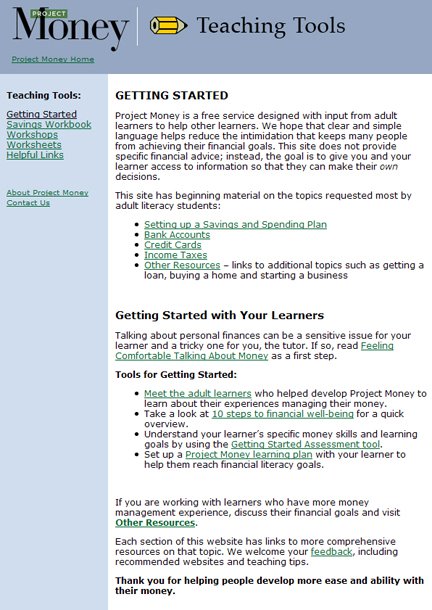
Notes from Project Money Workshop for Tutors


On Thursday, August 17, Project Read presented a continuing education workshop for volunteer tutors on the subject of helping adult learners achieve their financial literacy goals. This workshop focused on the learner-developed information (handbook and website) created by the Project Money team.

Highlights from the evening's workshop included:

A discussion of the barriers which prevent tutor-learner teams from working on financial goals. An excellent resource on this topic can be found on the Project Money website - www.projectmoney.org - in the Teaching Tools section. It's called "Feeling Comfortable Talking About Money" and it reviews reasons why adult learners may be sensitive about financial issues, and what tutors can do to make the learner feel safe in order to promote an open discussion of the topic. You can view this document at the following link: http://www.projectmoney.org/teaching/talking.html

We also discussed tools available on the website to help tutor-learner teams assess what the learner already knows about banking, credit, savings, etc., and what they need to learn: http://www.projectmoney.org/teaching/gettingstarted.doc (MS Word document) is a link to "Getting Started, a Self Assessment Tool". After working through this resource, you can go on to the next step of putting together a "Project Money Learning Plan": http://www.projectmoney.org/teaching/learningplan.doc (MS Word document).

Remember, the Project Money website has easy to understand information on many financial literacy topics. The information included on the site was researched and edited by adult learners themselves with the expert assistance of community advisors from financial institutions as well as volunteer tutors who then road- tested the instructional material.

Wednesday, August 02, 2006

Tips for Tutors from August Tutor Round Table

A newly-trained tutor from the July tutor training class joined the round table for the first time on Tuesday, August 1st. This turned out to be an excellent opportunity for her to get some great advice from the more experienced tutors at the table--exactly what the Tutor Round Tables are designed to do! Here are some of the questions she posed and the excellent responses she received.

  • How did you break the ice with your learner during your first meeting? One experienced tutor mentioned that it's always a good idea to talk a little bit about yourself and what brought you to Project Read as a volunteer. Another good suggestion was to bring the learner's Goals Sheet, which you received from the office, and have a discussion about which goals are most important to the learner and need to be worked on first.
  • How will I learn which instructional techniques work best for my learner? The experienced tutors all said that patience is the key. It doesn't happen overnight, but after a few sessions, you will get to know how your learner learns best and the techniques that resonate with his/her learning strengths.
  • How do I encourage my learner to use the computer lab, especially if he/she has never used computers before? One tutor mentioned that the process by which a new learner receives a Lab License is designed to make any learner comfortable with the hardware and software found in the Project Read computer lab. This step-by-step introduction to the lab can be completed with the help of a staff member, or with the tutor there as a coach. Another tutor made the comment that the computer lab is there to reinforce what you are already doing in your tutoring sessions, and learners that have the motivation and time to utilize the lab in between tutoring sessions can make even more progress towards their goals. There are adult learners who do not regularly use the lab, so it is not absolutely necessary to the one-to-one instructional program. A tutor at the Round Table mentioned that she and her learner had not yet gotten around to working in the lab, but she was intending to go to the lab with him at an upcoming tutoring session.

Wednesday, July 12, 2006

Continuing Education Workshop for Tutors
Thursday, August 17, 2006
6:00 - 7:30 PM
Latino-Hispanic Meeting Room
Main Library, Lower Level
TIPS FOR TUTORS FROM PROJECT MONEY
Join us to discover instructional strategies and tools to help your adult learner work on his or her financial literacy goals. We will cover both the outstanding web-based and print materials created by adult learners themselves as part of Project Money. Please call our office at (415) 557-4388 if you plan to attend.