Welcome to Write Away!
The writing forum for Project Read learners.

We've redesigned our blog so that adult learners working at Project Read can share what they have written with other learners, tutors, and the public. There are a few simple guidelines to be aware of.
  1. This is a moderated site, so submissions and comments will first be reviewed before being approved and published.
  2. Adult learners submitting their writing have the option of using their first name (only) or using "anonymous" for authorship.
  3. We wish to honor the writing efforts of the adult learner/authors, so no major copy editing will be applied, but we may suggest minor corrections in consultation with the author.
  4. Only active Project Read learners are eligible to submit their writing to the Write Away blog and there are two ways of doing this: send submissions via email to projectread@sfpl.org, or stop by the office with a hard copy of your writing.
  5. The views and opinions expressed on this web site are solely those of the original authors and contributors. These views and opinions do not represent those of the San Francisco Public Library and/or the City and County of San Francisco.

Wednesday, July 12, 2006

Continuing Education Workshop for Tutors
Thursday, August 17, 2006
6:00 - 7:30 PM
Latino-Hispanic Meeting Room
Main Library, Lower Level
TIPS FOR TUTORS FROM PROJECT MONEY
Join us to discover instructional strategies and tools to help your adult learner work on his or her financial literacy goals. We will cover both the outstanding web-based and print materials created by adult learners themselves as part of Project Money. Please call our office at (415) 557-4388 if you plan to attend.

Monday, June 19, 2006

Schedule of Tutor Round Table Meetings -- July through November 2006

Tutors: make plans to join your fellow Project Read volunteers and staff at an upcoming Tutor Round Table meeting. You'll find these informal get-togethers to be both educational and fun.

Here are the scheduled meeting dates for the rest of 2006:
Tuesday, July 11
Tuesday, August 1
Tuesday, September 5
Tuesday, October 3 and
Tuesday, November 7

The meetings take place in the Project Read Conference Room and begin at 6:00 PM. We provide some tasty pizza and beverages.
These informal discussions normally last one to one and a half hours depending on the number of tutors who attend. Please call our office at (415) 557-4388 if you plan to attend a Round Table meeting.

Friday, June 09, 2006

Tips for Tutors: Topics from the Tutor Round Table Meeting on June 6th

At the Tutor Round Table meeting in June we discussed some common challenges faced by Project Read tutor/learner teams.

  • One tutor at the meeting mentioned that her learner has difficulty understanding how and why punctuation is used. This problem occurs when reading and writing.

One suggestion offered involved using the technique of DUET READING to help the learner understand how punctuation is used to add meaning to any style of writing. As you recall in duet reading the tutor and learner read a text simultaneously. In this way, the learner can begin to hear how punctuation influences the flow of reading and the meaning of what is being read.

To help beginning writers understand the nuances of grammar and punctuation we have handy FREE books available in the Project Read office. Two that might be hepful are: Punctuation Power: Punctuation and How to Use it, and Write All About It.

  • We also discussed the challenge of teaching an adult learner about the structure of writing and how important it is to express oneself clearly in order for others to undersand what you've written.
It is always important to get the adult learner writing as much as possible. Even if the writing is done in a personal journal which is not shared with the tutor, this is still a valuable exercise for the leaner because it helps him or her become comfortable getting their thoughts down on paper. Other writing strategies you might try include dialog journals that are passed back and forth between the tutor and learner, and response writing in which the learner is writing his or her thoughts in response to a picture from a newspaper, magazine, or photo album.

  • Another tutor spoke about the word substitutions her learner often makes when reading aloud. The word substituted will often have just one incorrect letter which of course creates an entirely different word. For example the word blend may be substituted for the word bend.
It was suggested that the tutor might ask that the learner read the sentence again and hope that the mistake is corrected using the contextual clues in the sentence. Also, the tutor can isolate the misread word and create a quick word pattern exercise to show the difference between the correct word and the word that was read.

Join us for the next Tutor Round Table Meeting on Tuesday, July 11, from 6:00 - 7:00 pm in the Project Read Conference Room.

Friday, May 19, 2006

New Instructional Materials Available for Tutor-Learner Teams

The next time you visit the Project Read office, take a look at a few titles we’ve added to our FREE collection of instructional books.
  • Flipping Phonics, New Readers Press, 1997
    This is an excellent instructional tool for beginning or intermediate level learners who are working on basic phonics skills. By flipping through the letters and adding different beginning and ending consonants to the middle vowel sounds, learners will soon be able to read words more quickly as they begin to understand the sounds of the letters.
  • Action Grammar: Fast No-Hassle Answers on Everyday Usage and Punctuation, by Joanne Feirman, Fireside Books, 1995
    This little book answers any questions a tutor-learner team may have about grammar and punctuation. Clear examples are given for each rule, and the appendix includes a section covering the most commonly made mistakes.
  • Punctuate It Right! A Complete Quick-reference Guide to Modern Punctuation, by Harry Shaw, Harper-Collins, 1993
    This is a book for tutors who need to remind themselves of the rules of modern punctuation. It is a very comprehensive guide to punctuation; however, the explanations are probably too difficult for adult learners to use successfully on their own.
  • Writing with Style: Making Your Writing Stand Out, by Sue Young, Scholastic Books, 1997
    An excellent instructional tool for tutor-learner teams working on higher level writing skills, this book offers information on how to organize ideas before you write, create grammatically correct sentences, arrange sentences for maximum effect, create effective paragraphs, and proofread for mistakes.
  • Get Wise! Mastering Reading Comprehension Skills, by Nathan Barber, Thompson-Peterson’s, 2000
    This book is full of exercises and techniques that can help any reader improve basic comprehension skills. Although written humorously for middle and high school students, the techniques are still effective and the entertaining style could make it fun for a tutor-learner team to use.
  • Barron’s Pocket Guide to Study Tips, by George Ehrenhaft & William Armstrong, Barron’s Educational Series, 2004
    This book is an excellent resource for advanced level Project Read learners who are now, or soon will be, taking classes at the college level or preparing for the G.E.D. exam. It is full of techniques and strategies to improve time management, note taking, reading comprehension, working with individual learning styles, writing with clarity, and many more important topics.

Thursday, May 11, 2006

Project Read Learner Wins Writer to Writer Competition

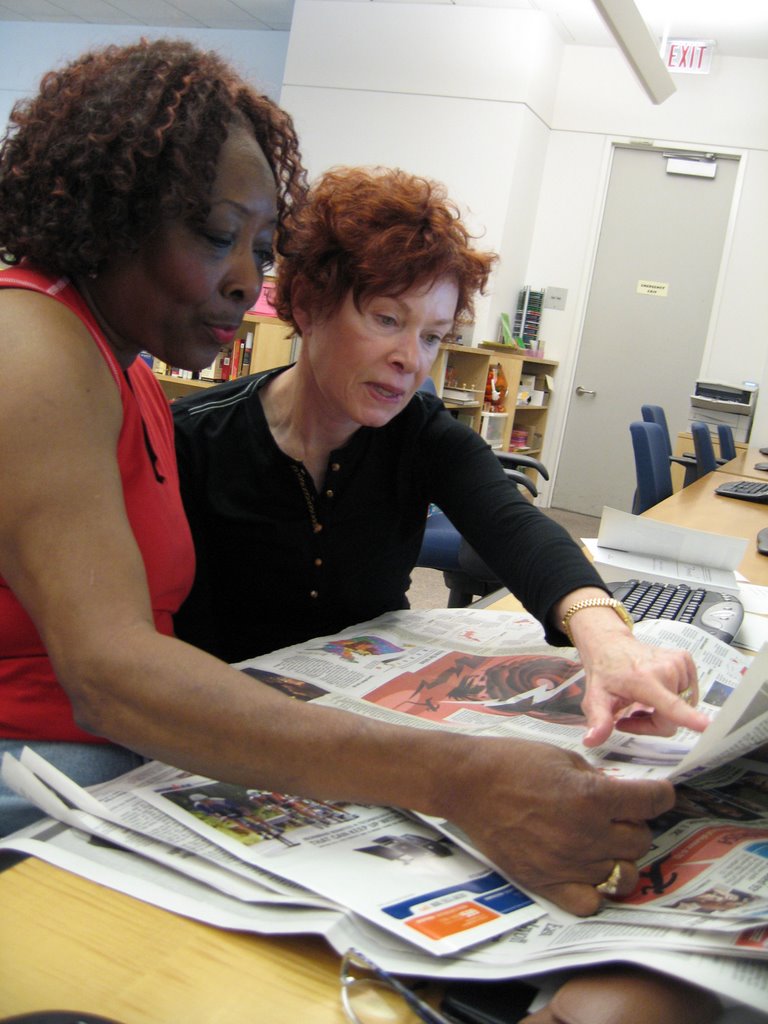
(Leona--left--working with her tutor Carol)

On May 11th, the California State Library and California Center for the Book announced the winners of the Writer to Writer Challenge for adult learners. Project Read's Leona Whytus was chosen as the winner in the category of beginning level learner. Leona submitted a letter she wrote to Mildred D. Taylor, author of Roll of Thunder, Hear My Cry. This was a book Leona read, along with other members of the Wednesday Night Readers book club, in February of this year.

The winners and finalists will be honored at the "Books Change Lives" Ceremony, hosted by the California Center for the Book, at the Santa Monica Public Library on June 3rd. Their letters will be posted onto the Center's website (www.calbook.org) and the California State Library will also publish a booklet of their letters.

Friday, April 21, 2006

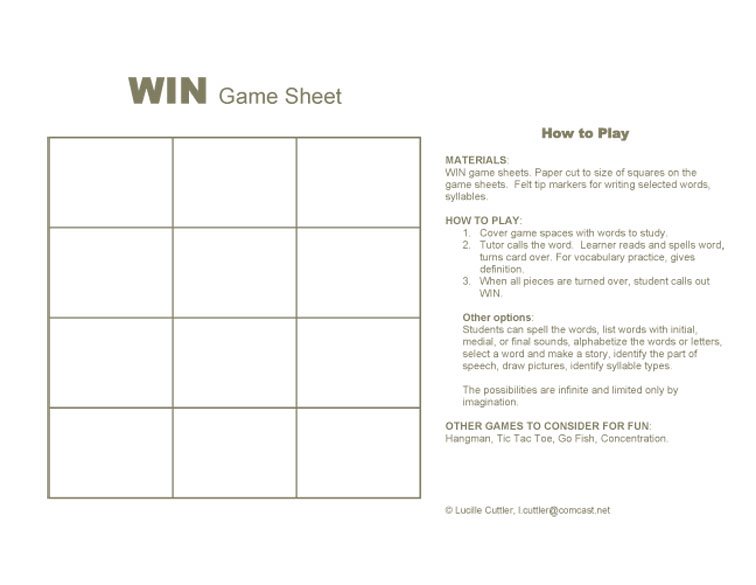
Tutor Tips: WIN Game

(click on graphic to view larger image)
WIN Game
A Fun Technique for Teaching Phonics and Spelling
From Keeping it Fun Workshop, April 20, 2006
(Lucille Cutler, l.cuttler@comcast.net)

Friday, April 07, 2006

Tips From Tutors

At the Tutor Round Table meeting on April 4th, we discussed...
  • What to do when learners guess at words when reading or writing, and the words they are guessing are not phonetically similar to the correct word. One suggestion made was to help the learner understand the sound-symbol relationships of the difficult word by working with word patterns. Together build a list of other words containing the same ending sounds, but with different beginning consonants, so that the learner can see the pattern for spelling the sound.
  • How to encourage reluctant writers. One of our tutors brought in a fun and helpful book that can assist anyone suffering from writer's block. The title is: The Write Brain Workbook: 366 Exercises to Librarte Your Writing by Bonnie Neubauer. Here's what the publisher has to say: "Provides 366 10-minute exercises to build momentum and turn off the left side of the brain. Helps readers generate work by painlessly leading them into new writing every day. Stimulates creativity with a stunning color package and easy-to-approach prompts." We will try to order a few copies of this title to have on hand in the Project Read office.

Tuesday, April 04, 2006

Tips From March 7, 2006 Tutor Roundtable

We had a wonderful Tutor Roundtable on March 7, 2006 with tutors Lucille, Alla, Joe, Michele, and Fedra.

Here are some tips that came out of that meeting.

  • Don't just teach spelling and grammar rules. Build interesting lessons around the rules.
  • NTC’s Easily Confused Words by Deborah K. Williams is a very useful book. It can be found in the Main Library's International collection. Project Read is going to order some copies and will make them available in the office.
  • It can be very beneficial to sessions if a tutor keeps things organized and structured.
  • Add some variety to your tutoring sessions. Do some different things to keep it interesting.
  • Use the SFPL Learning Express online materials. There is a direct link from the Computer Learning Lab Links page.
  • It can be an effective writing strategy to do some lessons around writing directions (driving, cooking, using a computer program, or anything that is of interest).
  • Don't get discouraged if it seems like progress is slow. It takes time - just keep at it. Practice leads to increased fluency and improved skills.
  • If a learner can't meet consistently and / or doesn't have the time to do outside activities that reinforce what is learned in the sessions - then perhaps it is not the right time for that learner to be in our program. He/she can take a break and resume tutoring when his/her schedule can better support ongoing tutoring.
  • Request: Could Project Read create some kind of organized method for accessing old and late breaking tutor tips and other resources?
  • Response: Yes, we are working on a blog. In fact, here it is. Enjoy!

Thursday, January 05, 2006

Welcome


This is a blog for Project Read. We are a free service of the San Francisco Public Library. We train volunteers from the community and match them with English-speaking adults who wish to improve their reading and writing skills.

We'll use this blog to share news and helpful tips. We'll add entries on a fairly regular basis so do drop by and visit us again. You can also keep up with us by copying and pasting our Atom Site Feed link into a My Yahoo page or other site feed reader.

All the best (and a smidge more), Brian